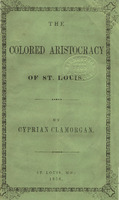
The Colored Aristocracy of St. Louis
In The Colored Aristocracy of St. Louis, a small volume published in 1858, Cyprian Clamorgan profiled 41 members of St. Louis’s free Black elite, describing their characters and appearances, occupations, families, and intimate lives, and evaluating their wealth and political influence and how they acquired it.
Clamorgan, himself a member of St. Louis’s Black Aristocracy, had a twofold purpose. Amid intensified debate over the status of people of color in the wake of the Dred Scott Decision, he sought to prove to white society that Black people were not a monolith solely defined by race. He also saw an opportunity to promote sales and make money by sharing tantalizing gossip among neighbors. Historian Julie Winch writes, “White people might thumb through its pages because they thought it promised amusing, and possibly scurrilous, anecdotes, or because they were outraged at the very notion of a ‘colored aristocracy’ and were eager to read Clamorgan’s arguments so they could demolish them. As for free people of color, who among them could resist seeing whether Clamorgan had included them in his ‘aristocracy,’ or reading what he had to say about their neighbors? And, with a name like Clamorgan, he was assured of a readership. Who better to comment on ‘the colored aristocracy of St. Louis’ than a man whose family had been a vital part of that aristocracy for decades?” Ultimately, Winch says, “The result was a series of witty and entertaining vignettes linked by a serious message about race, class, and power.”
The Colored Aristocracy of St. Louis offers a window into the rich, varied lives and stories of free people of color in a critical period of St. Louis history when enslavement of Black people was the norm and the political status of free Black Americans was hotly contested. However, while Clamorgan presents the biographies and events in his pamphlet as fact, the tone is more one of a “gossip rag.” Clamorgan’s assessment of the people he profiled are shaped by his own perspectives. As a fellow member of the Black Aristocracy, he had his own alliances, family connections, and prejudices that shaped who he praised and who he spoke of pejoratively, who he considered rightful members of this Black “first class,” and who did not belong. Thus, these profiles should not be viewed alone as a true representation of the people they depict, but of how Clamorgan viewed them. Comparison with other sources may provide a more representative picture of their lives.
View Additional Resources to learn more about the Black Aristocracy of St. Louis, Cyprian Clamorgan, and his family.
Click book cover to view the contents