About the Circuit Court Records
Since the official transfer of the Louisiana Purchase and the inception of the United States court system in 1804, the St. Louis Circuit Court has produced many different series of records including minutes, dockets, attorneys' rolls, journals, registers and case files. All records from the 1804-1875 period in the custody of the Circuit Court are housed at the Missouri State Archives-St. Louis.
The primary focus of archival work thus far has been concentrated on the case files, where much of the detail about cases filed in the courts is contained.
Description of the Records
St. Louis Circuit Court Case Files
The case files consist of civil, criminal and chancery actions filed in the St. Louis Circuit court, its predecessors and subsidiary courts. They possess exceptional evidential, informational, and intrinsic value, documenting the legal basis of the early court system, profiling local individuals of national prominence, and illustrating broad themes of American intellectual and social history.
To facilitate research in distinctive areas of national, regional, and local history, case files dealing with specific topics are presented here as artificial, subject-oriented records series, however these files remain part of the larger St. Louis Circuit Court Case File records series.
Information Contained in the Records
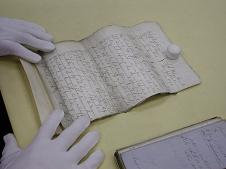
The St. Louis Circuit Court records possess exceptional evidential, informational, and intrinsic value. They document the legal basis of the early court system, profile local individuals of national prominence, and illustrate broad themes of American intellectual and social history. There is no other judicial collection of comparable value in the United Sates that documents Westward Expansion.
The bulk of the records document the case history of civil suits brought by ordinary men and women pursuing justice in disputes over debts, damages and broken promises. Criminal cases dealing with theft, destruction of property, slander, and murder are also well represented. Chancery cases are less numerous, but deal with the equitable distribution of property such as in divorce and land partition cases.
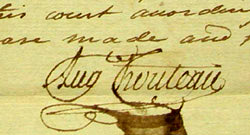
Historical figures featured in these records include Meriwether Lewis, William Clark, and Moses and Stephen F. Austin, and others prominent in the United States' westward expansion. Other cases involve Missouri's most important nineteenth century U.S. Senator, Thomas Hart Benton, St. Louis's founder Auguste Chouteau, and fur-trade entrepreneur Manual Lisa. The original court case filed by Dred and Harriet Scott is just one of approximately 300 freedom suits.
Case files and record books contain many thousands of pages related to the early fur trade, steamboats, western travel, territorial militia, relations between settlers and Indigenous people, divorce, immigration, business, commerce, and the Civil War and Reconstruction.
Condition of the Records
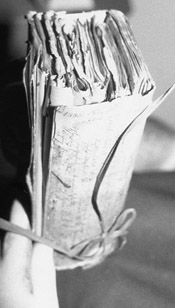
The greatest threat to the St. Louis Circuit Court's records has come from their storage conditions. In their more than 200-year history, they have been stored in various court buildings which long pre-dated the advent of air-conditioning. Thus, they have been subjected to dirt, industrial/urban pollution from coal-based heating and the internal combustion engine, and extremes of temperature and humidity. Like most court records, they were tri-folded for storage in metal till drawers.
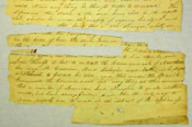
Most of the paper is fragile; some of it is brittle, probably due to acid formation or desiccation. Iron gall ink has further weakened the paper, sometimes eating through it. Most sheets have some tears, and many have broken along the fold lines. There are heavy accumulations of surface dirt, especially along the top and outer edges. Fortunately, much of the collection has benefited from "benign neglect." There are few tape repairs, no lamination, and no paper clips, staples, or rubber bands. It is mostly in original order and remarkably complete.
Use is the secondary cause of damage. Documents that have been consulted show tears and breaks. Often-consulted documents, record books, and indices have heavy surface dirt in places, bindings are broken, and some tape repairs have been applied. Ironically, the most high-profile documents have sustained the greatest damage. In years long past, employees have applied adhesive tape to some of the most important documents. While this treatment was applied in an effort to protect the documents, current knowledge shows us that those efforts - however well intentioned - have caused further damage.