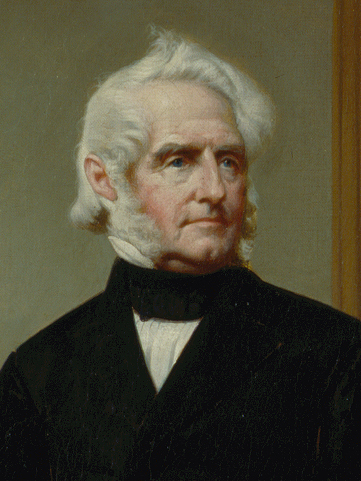
Hamilton Gamble served in the Missouri State Legislature from 1846-1851. He was elected to the Missouri Supreme Court as supreme justice where he presided over the Dred Scott v. Emerson case and dissented his colleagues’ vote to overturn the case. He believed Scott was free because he had already been free. Although Gamble believed Scott to be free, earlier in 1829 he defended Garland Rucker against Maria Whiten and her son Patrick Henry who were suing Rucker for their freedom. Gamble became the provisional governor of Missouri in 1861.
Hamilton C. Williams and his brother Larkin Wiliams both owned land on the southern side of what would become Tyson Research Center. They were both a part of the large Williams family that had a significant presence in Missouri during the early 1800s. This family was also known to have sympathy toward the Confederacy during the Civil War and were likely enslavers.
Hale Giddings Parker was among the first Black students to attend Washington University in St. Louis. An Ohio native and 1873 graduate of Oberlin College, Parker entered the university’s law school in the late 1870s. Although he completed his coursework, he was denied a law degree after reportedly scoring one point below the passing mark on his final exam. Despite this setback, Parker went on to a distinguished legal and civic career across the Midwest. He served as alternate commissioner-at-large for the 1893 World’s Columbian Exposition in Chicago, where he confronted organizers over the exclusion of African American exhibits. In 1916, Parker’s former classmate David Castleman Webb led an effort to secure him an honorary law degree, but Chancellor Frederick Hall refused, further erasing his legacy within the university’s history.
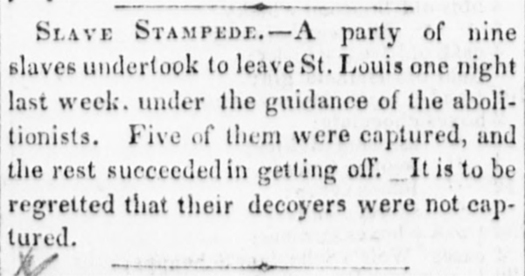
Glasgow Weekly Times describes that nine enslaved people attempted to escape "under the guide of the abolitionists," and that five were captured, but others "succeeded in getting off." The newspaper account also regrettably mentions that the "decoyers" were not captured.
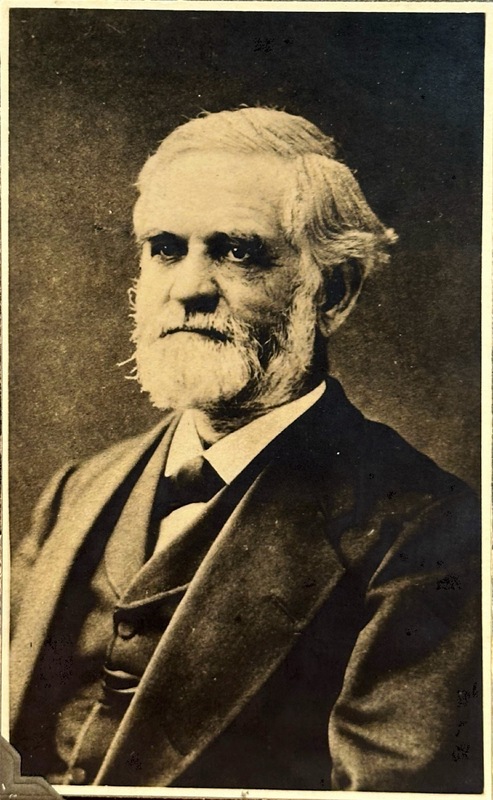
George Washington Goode, a proslavery lawyer from Virginia, owned land on what is part of present-day Tyson in 1862. He served as the attorney for the Emerson-Sandford family in the infamous 1846 court case Dred Scott v. Sandford, through which Dred and Harriet Scott sued for their freedom, which decided in 1857 that not only were the Scotts not eligible for freedom, but that all Black people were not citizens of the United States.
Goode enslaved several people. In March 1848, Goode purchased Benjamin for $605 from the estate of George H. Lanham. In 1850, he held seven people in slavery, and enslaved seventeen people in 1860. In 1846, Goode served as security for Ellen Butler’s freedom license, and for Edward Woodson in 1847.
In this StoryMap, student researcher Julia Feller explores the history of self-liberation and St. Louis' Underground Railroad through the heroic and tragic story of Esther. Born into slavery ca. 1811, Esther was one of several people enslaved by WashU benefactor Henry Shaw (founder of the Dept. of Botany), and who fled in search of freedom in 1855.
Enoch Holcomb (1799 – 1852) owned property within what is now Tyson Research Center according to plat maps from 1838 and 1846. No records have yet been found indicating that Holcomb or members of his family were enslavers.
Elizabeth L. Hart Coats (1812-1859) received land from her father, Henry C. Hart, which the U.S. government granted to him for his military service in the War of 1812. Elizabeth Hart settled in Missouri and married James Coats.
The Harts were enslavers. In 1855, Henry C. Hart and Elizabeth L. Hart emancipated Susan, a 25-year-old woman described as married to George Kibby on December 4, 1855. It is possible, but not confirmed, that a Henry Hart in the 1840 St. Louis census who enslaved one young woman was the same Henry C. Hart. According to the 1860 Census, H. Clay Hart enslaved 14 people in Carondelet: three women ages 60, 30, and 22, four men ages 35, 32, 24, and 21, a 17-year-old youth, four boys ages 13, 10, 6, and 4, and two girls ages 3 and six months.
Elias Browne Cockey (1800 –1838) held land on what is now Tyson Research Center property according to an 1838 plat map. Cockey was killed the same year by James H. Dougherty, with whom he had a contract to deliver 1,000 saw logs. After Cockey’s death, James, a man he enslaved, was sold at auction.
Elbert A. Walton Jr. was a student at Washington University and a member of the Association of Black Collegians (ABC) during the 1960s. In December 1968, his arrest and alleged beating by campus police over parking violations ignited a major student protest. Forty Black students occupied the campus security office in response, catalyzing one of the most significant demonstrations in WashU’s history. Walton later became an attorney and public official, continuing his advocacy for civil rights and community empowerment.
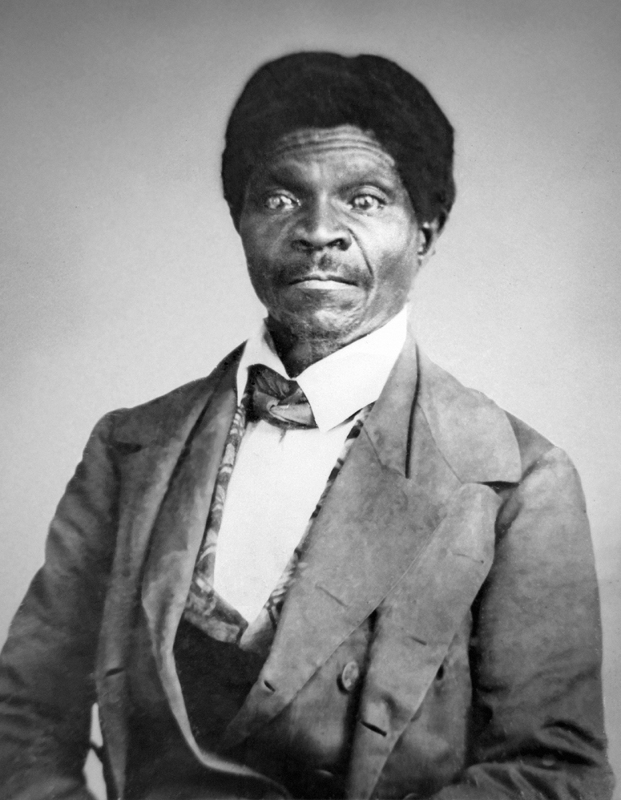
Dred Scott sued for his and his family's freedom in the 1857 case Dred Scott v. Sandford, whose conclusion that the Scotts were not free and no Black person was considered a U.S. citzen is known as 'The Dred Scott Decision.' For four decades leading up to this case, enslaved people could sue for their freedom and win due to the 'once free, always free’ concept. This applied to enslaved people who had spent some time in a free state, as Dred Scott and his wife Harriet had done. After they traveled south to St. Louis with their enslaver, Dr. John Emerson, they faced the uncertainty over their freedom and keeping their family together. When Emerson died, Scott first attempted to purchase his freedom, but Emerson's wife, Irene Sanford, refused. Scott sued and his case eventually reached the United States Supreme Court. Scott was never able to gain his freedom in court, but eventually Irene Sanford transferred the Scotts to Henry Taylor Blow, the son of Dred Scott’s enslaver before Emerson, who granted the family their freedom.
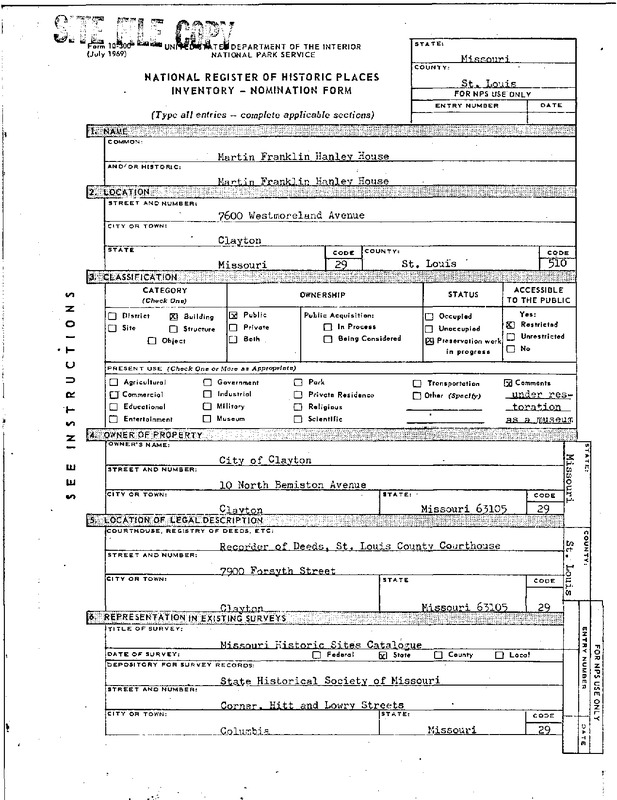
This register documents Hanley House as " one ofthe only ordinary Missouri houses of its style and period to have survived" and that it is worth preservation. The register also notes that the Hanley family were slaveholders.
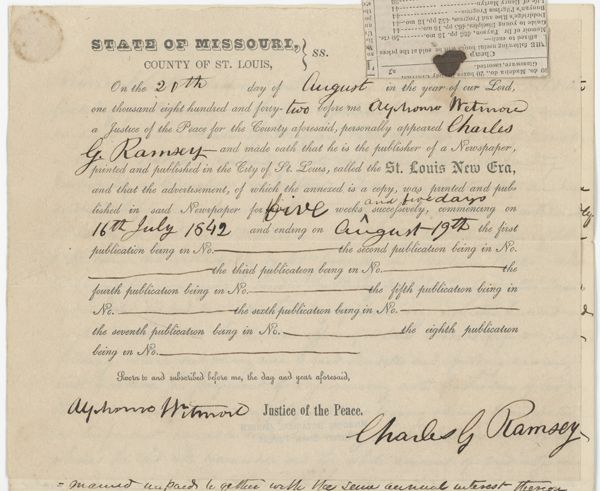
Deed of trust & notice of affidavit of the trustees' sale of property on St. Louis New Era (newspaper). Mentions that the advertisement of the property would be displayed in the newspaper for five weeks and five days, from July 16th, 1842 to August 19th.
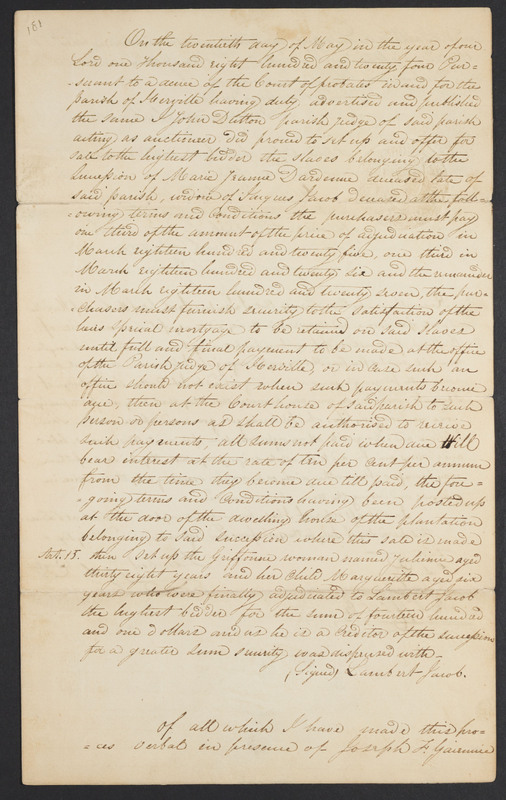
This document, dated July 14, 1836, records the manumission of two Black enslaved persons, Julienne and Marguerite, by the enslaver Lambert Jacob in St. Louis, Missouri. Julienne, aged thirty-eight, and her six-year-old daughter, Marguerite, were previously adjudicated to Lambert Jacob as part of the succession of Marie Jean Dardenne in Iberville Parish, Louisiana. Jacob granted their freedom with the condition that they would serve him during his lifetime. The deed was formally acknowledged in the St. Louis Circuit Court, marking the legal release of Julienne and Marguerite from slavery, except for the lifetime service clause imposed by Jacob.
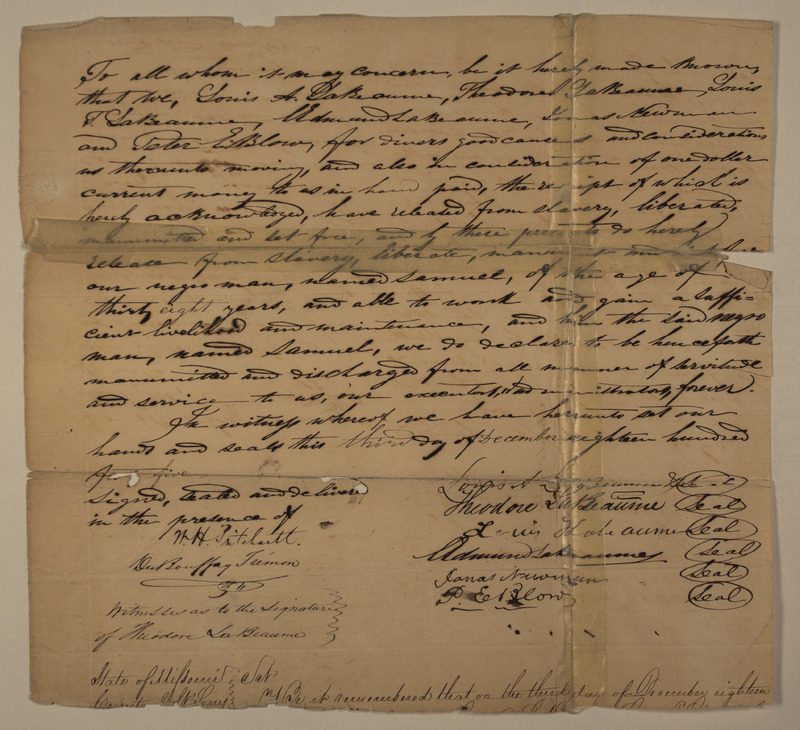
This document, dated December 3, 1845, records the emancipation of Samuel, a 38-year-old Black man, by Louis A. LaBeaume, Theodore LaBeaume, Louis T. LaBeaume, Edmund LaBeaume, Laura LaBeaume, and Peter E. Blow—enslavers in St. Louis, Missouri. The deed officially grants Samuel his freedom, declaring him manumitted and released from all servitude to the LaBeaume family and their heirs. The document also mentions a nominal payment of one dollar, symbolizing the legal transaction.
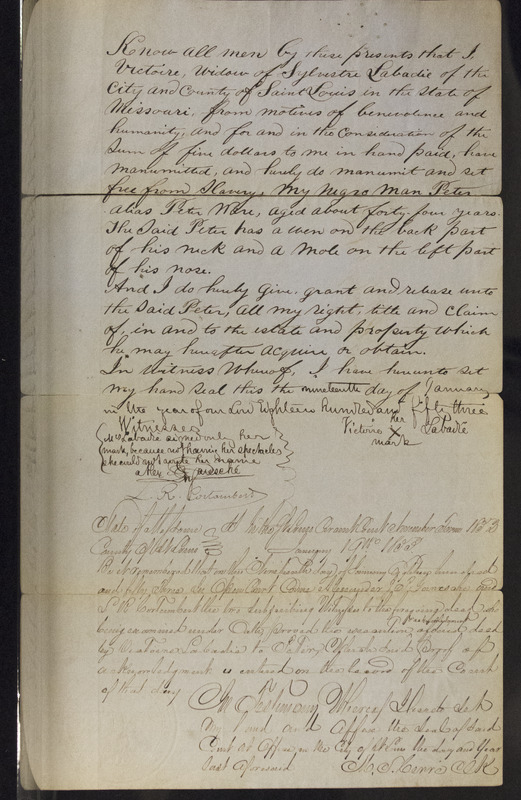
Deed of Emancipation for Peter Ware by Victoire Labadie, widow of Sylvestre Labadie, St. Louis, Missouri, January 19, 1853. Victoire Labadie formally emancipated Peter, a Black man aged about forty-four years, marking him free from enslavement. The document describes Peter's physical features, including a mark on the back of his neck and a mole on the left side of his nose.
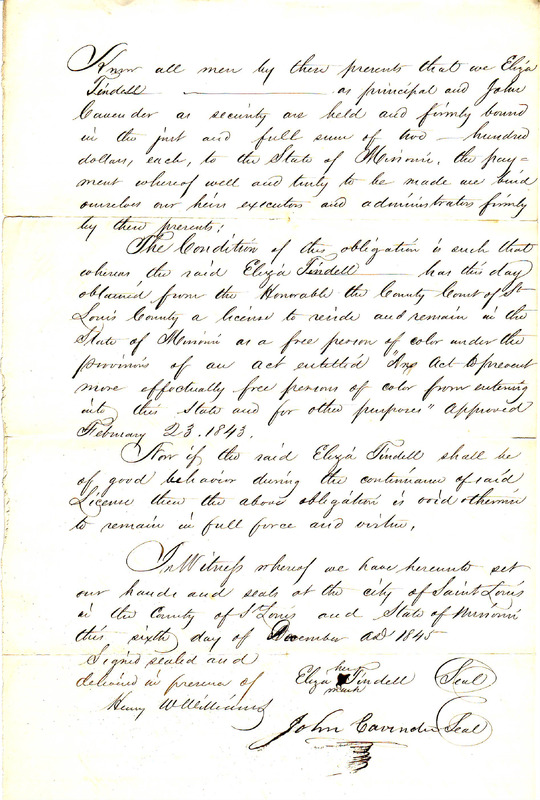
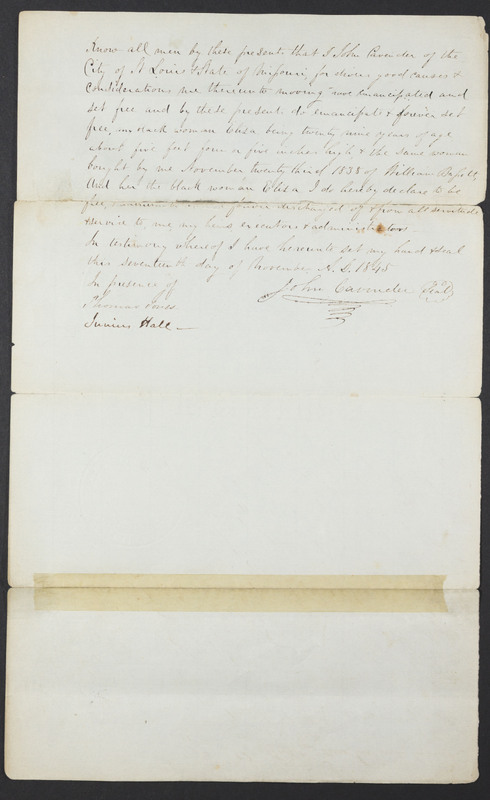
Deed of Emancipation for Eliza, a Black woman approximately twenty-nine years old, by John Cavender, St. Louis, Missouri, November 17, 1845. The deed, acknowledged in the St. Louis Circuit Court, formally grants Eliza her freedom, releasing her from all servitude to Cavender and his heirs. Eliza, who is described as being about five feet four or five inches tall, was purchased by Cavender in 1838 from the enslaver William Baf.