Three generations of the Mincke family held land on what is present-day Tyson Research Center. They appear on plat maps of present-day Tyson from 1870 until the federal government obtained the land in 1941. The Mincke family left a significant mark on the land, and the remains of the town and quarry cave from their limestone mining operation exist on Tyson’s property to this day. An 1870 plat map reports brothers George Ferdinand Mincke, Jr. (1829 – 1905), and Julius Henry Mincke, Sr. (1826 – 1887) as landholders at what is now Tyson. In 1877, they began operating a limestone quarry on their land at Tyson, establishing the small town of Mincke where the workers and their families lived. The mine ran until 1927, at which point the fifty-year lease expired and the mining company moved on. During and beyond the fifty-year lifetime of the Mincke Quarry, the land passed through different hands within the Mincke family. In 1893, a Jos. H. Mincke appears on a plat map. This is believed to be George F. Mincke’s daughter, Josephine, (1868 – 1966). Josephine, a schoolteacher, was also a secretary at the family company in St. Louis, Mincke Monolithic Products, which produced granite products such as headstones, lampposts, and retaining walls. Julius Henry Mincke’s son, Henry Julius Mincke (1866 – 1953), appears as a landholder on a 1909 plat map of the area that is now Tyson Research Center. Henry owned several farm and gravel properties on the Meramec River. In a 1930 plat map, Henry’s son, Julius Henry Mincke Jr. (1900 – 1982), is listed as the landholder.
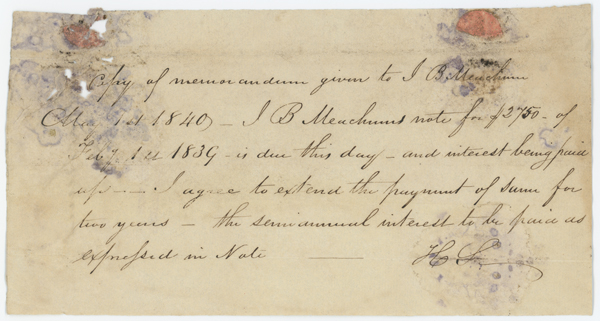
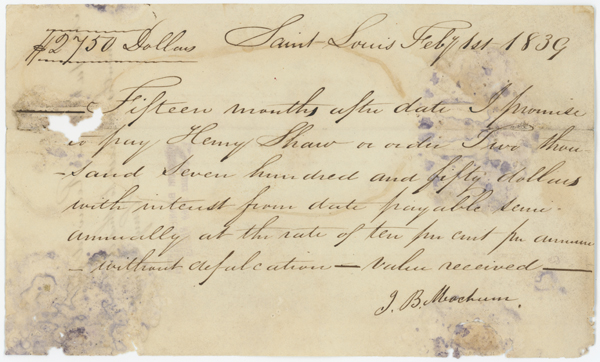
A memorandum dated 1 May 1840 for a two-year extension of the $2750.00 loan agreement between John Berry Meachum and Henry Shaw was issued on 1 February 1839. The memorandum states that Meachum paid the interest on the loan from February 1st, 1839.
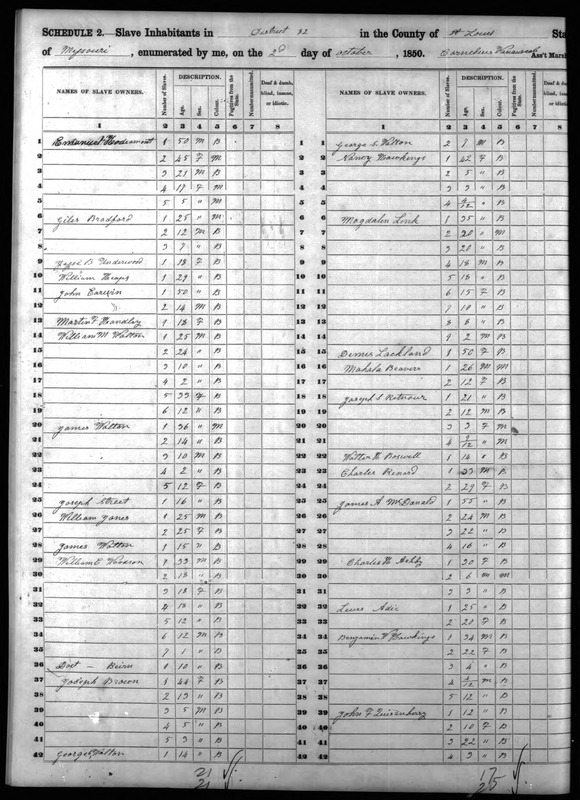
This is the 1850 Census of Martin F. Hanley, and in it is listed that he has one slave. Presumably that is Lydia Jackson who is mentioned in the other Hanley House papers. She is 18 at the time of this census and is labeled as Black.
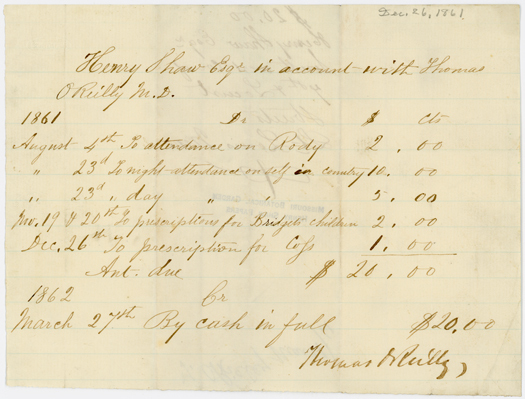
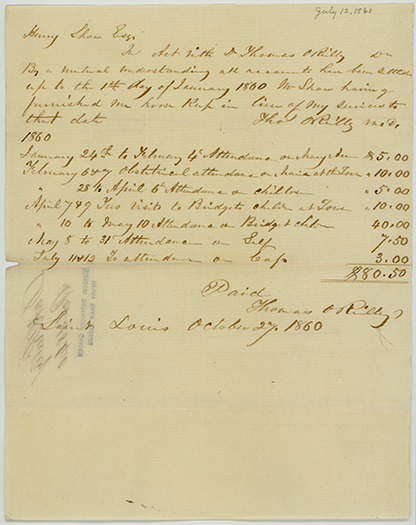
Maria was enslaved by Henry Shaw according to a bill with Dr. Thomas O’Reilly for obstetrical attendance on February 6 and 7, 1860 at Tower Grove, which indicates that Maria was pregnant. and—if she survived—may have had a child.
Malinda Jane Sullens Byrnes is the daughter-in-law of Tyson landowner Samuel Byrnes, the sister-in-law of Tyson landowner William C. Byrnes, and the niece of Tyson landowners Hamilton C. Williams and Larkin Williams.
Loan agreement for $2750.00 between John Berry Meachum and Henry Shaw, 1 February 1839 with interest. Describes that Shaw received interest of fifteen months in the back.
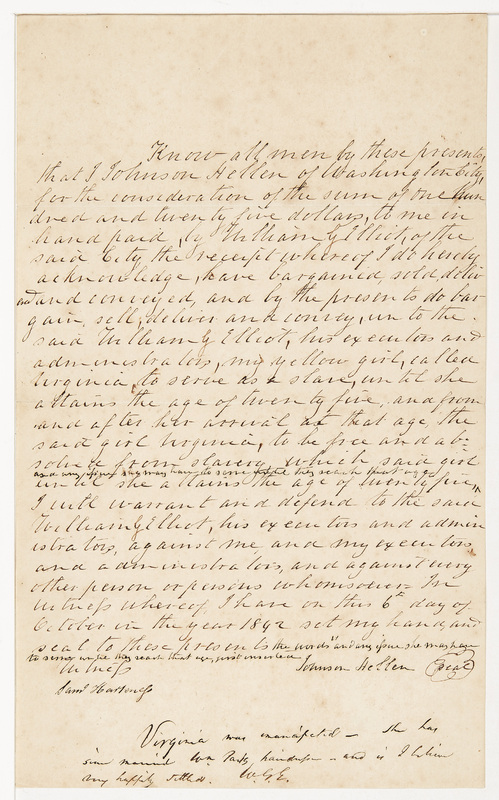
Letter from Johnson Hellen, enslaver, to William Greenleaf Eliot, which included a stipulation for Virginia’s freedom from enslavement at age twenty-five. Additional note by Eliot states Virginia was emancipated and married William Parks, handyman. Johnson Hellen was from Washington City.
Larkin Williams and his brother Hamilton Williams both owned land on the southern side of what would become Tyson Research Center. They were part of the large Williams family that had a significant presence in Missouri during the early 1800s. This family was also known to have sympathy toward the Confederates during the Civil War and were likely enslavers.
Juliette was born and raised in the family of Antoine Chenie, who sold her, through Lucien Dumaine, to Henry Shaw on May 20, 1836, when she was about twenty-one years old. Juliette remained enslaved until she obtained freedom from Shaw at about the age of 23 on April 24, 1839.