
Items
In item set
Documenting Ferguson Community Archive
621–640 of 792
Advanced search
-
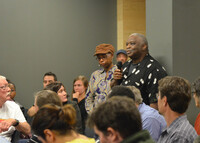 Facing Ferguson: Historical, Legal and Political Contexts (panel discussion) Panel discussion at the University of Kansas
-
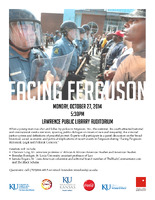 Facing Ferguson: Historical, Legal and Political Contexts (panel discussion) When a young man was shot and killed by police in Ferguson, Mo., this summer, his death attracted national and international media attention, spurring public dialogue on issues of race and inequality, the criminal justice system and definitions of peaceful protest. Experts will participate in a panel discussion on the broad historical, social, economic and political implications of recent events in Ferguson during "Facing Ferguson: Historical, Legal and Political Contexts." Panelists will include: Clarence Lang, KU associate professor of African & African-American Studies and American Studies Brendan Roediger, St. Louis University assistant professor of Law Jamala Rogers, St. Louis American columnist and editorial board member of TheBlackCommentator.com and The Black Scholar. Monday, October 27, 2014 5:30PM Lawrence Public Library Auditorium Questions: call (785)864-4815 or email: [email protected]
-
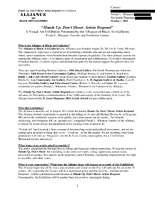 Exhibition Press Release: Hands Up, Don't Shoot This is the press release for the "Hands Up, Don't Shoot" exhibition organized by Freida Wheaton.
-
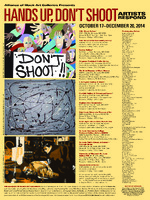 Exhibition Poster: Hands Up Don't Shoot: Artists Respond The Alliance invited visual artists to respond to the killing of 18-year old Michael Brown, Jr. in Ferguson, MO and to the worldwide reaction of the public, law enforcement and the media. This historic awakening, with Fe rguson, MO as "ground zero" compelled Freida L. Wheaton, founder of the Alliance, to initiate St. Louis artistic documentation of the ensuing events as protest art. "Protest Art" has historically been a means of documenting social and political movements, and we are calling upon all artists to bring their voice—visual art—to the Movement. We are recording what future generations will view as "Ferguson:" not the St. Louis County municipality, but a 21st Century Movement for law and justice.
-
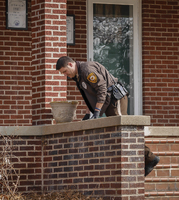 Evidence A police officer looks for evidence at a house on Tiffin Avenue following the shooting of two police officers.
-
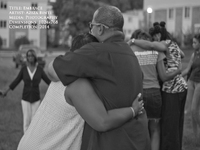 Embrace During a meeting in the Canfield Green Apartments a resident is held by a member of clergy after talking about the pain in her community.
-
 Documenting Ferguson promotional video Video compiled of images and audio in the Documenting Ferguson collection.
-
 DocNow Advisory Board Meeting 2016 Panel 6: Web Archiving Technology in the Age of Social Media The technical solutions around web and social media archiving continue to advance. While traditional web archiving has a more established history, social media platforms are bringing new challenges to this space. Panelists will discuss the similarities and differences in these closely related, yet uniquely different, spaces and how our technical approaches to archiving them can move forward in a more collaborative and interoperable way.
-
DocNow Advisory Board Meeting 2016 Panel 5: Social Media Archiving and Community Documentation Social media has created new opportunities for people from traditionally underrepresented groups to directly engage with the public. This direct access and open engagement presents tremendous opportunities for archivists to better document and take part in open dialogue with communities, whose histories and narratives were not widely accessible in the past. This new access also raises issues the value of social media as valid historical records and ethics concerns including privacy of social media users. How can archivists balance those issues versus professional mandates for documentation? Panelists will discuss their work to document various communities and the challenges, conflicts and opportunities for using social media as a gateway to community documentation.
-
DocNow Advisory Board Meeting 2016 Panel 4: Social Media Research Data, Tools, and Methodologies Social media presents tremendous opportunities for research but available tools for collection and analysis of that data come with tremendous technical, access, functionality, and cost barriers. Panelists will describe their research with social media data and how available tools for social media collection and analysis support their work, where those tools can be improved or how new tools can address their needs. Panelists will also offer perspectives on how a tool like DocNow can address some of the issues they encounter when working with social media data, and DocNow features and functionality that will be useful to them moving forward.
-
DocNow Advisory Board Meeting 2016 Panel 3: Ethics of Social Media Collection and Use The ethical issues around the collection, preservation, access, and use of social media data are complicated and numerous. These issues revolve around consent, user intent, and privacy, among others. They present added complexity for archivists, as one of our main goals is the long-term preservation of records. They also present added complexity for journalists and others who might want to collect and explore social media content for their work. Panelists will discuss how ethical considerations complicate their work to collect, provide access to, or to analyze and interpret records on social media platforms. They will also discuss possible solutions to some of the issues they face.
-
DocNow Advisory Board Meeting 2016 Panel 2: Social Media and a Record of the Movement Beginning in August 2014, after the killing of Michael Brown, activists in Ferguson, Missouri forced a nation to pay attention to the epidemic of police violence against African Americans. Ferguson was central to the mainstreaming of what is now commonly referred to as the Black Lives Matter movement. Michael Brown’s family and neighbors, local community organizers, and protestors in Ferguson controlled the narrative of this story from the very beginning and the story was shared with the world, in large part, via social media platforms. Without their work in the streets and their ingenuity to amplify their stories via new media, it is likely Michael Brown’s story would not have been as widely known and Ferguson would not have been the catalyst for this social justice movement. The panelists, all of whom participated in the initial Ferguson protests and organizing that lasted almost a year, and who are still engaged in local community organizing today, will discuss their work over the past two years, how that work continues, and the impact of social media in the early days of their organizing. The panel will also offer perspectives on how they see their current and past activities being remembered, and what role, if any, they see for social media presenting a record of the movement for future audiences.
-
DocNow Advisory Board Meeting 2016 Panel 1: Social Media and Opportunities for Research in African American History and Culture African Americans and other marginalized people are some of the earliest adopters and heaviest users of social media platforms. From #Ferguson to #BlackLivesMatter, they use these platforms to come together around shared culture, to generate new narratives, to engage with the public without filters, and to consume content on their own terms. Social media has been a powerful tool for the further democratization of information sharing and consumption. What new opportunities do social media platforms, their users, and the records they generate, present for research on marginalized people in academic fields such as history, sociology, communications studies, journalism, etc? Panelists will draw on their own work and also offer perspectives on new opportunities in social media research in their respective fields.
-
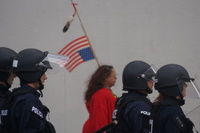 Distress Ferguson Protestor walking with the American Flag upside down realizing the upside down flag is a signal of distress
-
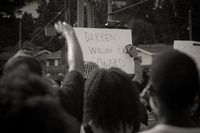 Darren Wilson is a coward sign. Darren Wilson is a coward sign. August 17, 2014
-
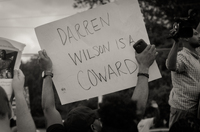 Darren Wilson is a coward sign (close up) Darren Wilson is a coward sign (close up) August 17, 2014
621–640 of 792